


Top Spy Agencies of Pakistan: Inside ISI, IB & MI | The 3 Most Powerful Intelligence Forces
- M.Zubair

- Dec 11, 2025
- 5 min read
Updated: Dec 12, 2025
Top Spy Agencies of Pakistan: Inside the 3 Most Powerful Intelligence Forces
Introduction: The Hidden World Behind Pakistan’s Security Shield
When people talk about intelligence organizations on the global stage, names like CIA, MI6, and Mossad often dominate the discussion. Yet, among them are agencies that operate just as effectively often more quietly, more strategically, and with far fewer resources.
And that brings us to the Top Spy Agencies of Pakistan, a topic loaded with intrigue, secrecy, and real world impact.
For decades, Pakistan’s intelligence network has played a pivotal role in shaping regional geopolitics, countering terrorism, managing internal security, and safeguarding national interests. Whether it is covert operations across borders or intercepting internal threats before they escalate, these agencies leave a substantial footprint often one the world never sees.
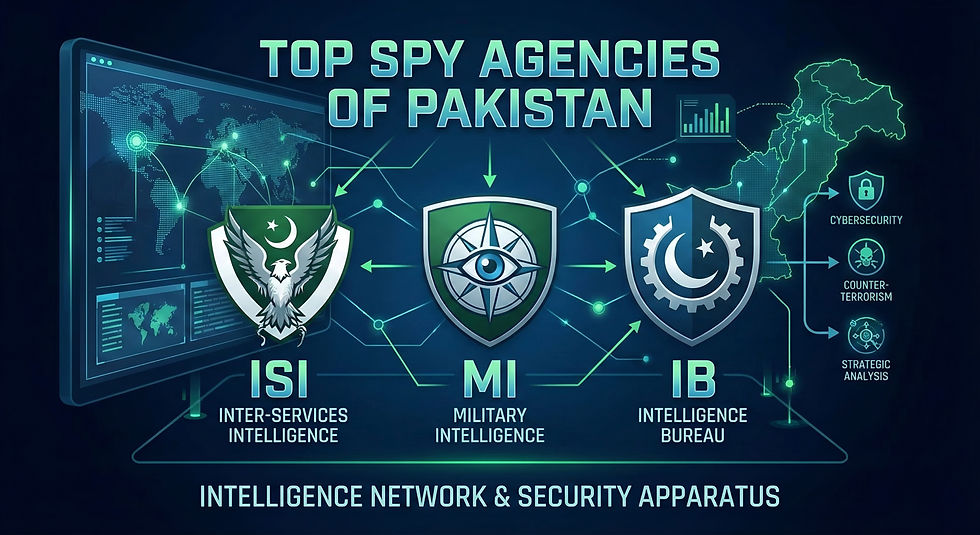
In this blog, we dive deep into Pakistan’s three most powerful spy agencies: ISI, IB, and MI. Beyond the surface level descriptions you usually find online, you will find real insights, comparative analysis, and perspectives shaped by years of observing regional intelligence developments.
Overview of the Top Spy Agencies of Pakistan
Pakistan operates multiple intelligence units, but three stand at the apex:
ISI Inter Services Intelligence (External + Internal Intelligence)
IB Intelligence Bureau (Domestic Counter Intelligence and Internal Security)
MI Military Intelligence (Military Focused Intelligence Operations)
Each agency has a distinct mandate, structure, and operational philosophy but together, they form Pakistan’s invisible defensive architecture.
1. ISI Inter-Services Intelligence (Pakistan’s Most Powerful Spy Agency)


Why ISI Ranks Among the World’s Most Influential Intelligence Agencies
ISI is Pakistan’s premier intelligence organization, often included in global lists of top intelligence agencies due to its:
Far reaching external intelligence network
Strategic influence in South Asia
Strong coordination with Pakistan’s military
Deep involvement in counterterrorism, cyber intelligence, and geopolitical operations
ISI’s strength lies not only in its capability but its unpredictability. Unlike Western agencies bound by extensive transparency requirements, ISI functions in a highly classified environment with operational autonomy.
Key Responsibilities of ISI
Foreign intelligence gathering
Counterterrorism and counter espionage
Monitoring hostile agencies
Strategic defense advisory to Pakistan’s leadership
Cybersecurity and digital surveillance
Supporting military intelligence operations
Unique Insight: What Sets ISI Apart?
While studying South Asian security dynamics over the years, one consistent factor becomes clear: ISI’s success often comes from asymmetrical strategies rather than overwhelming resources.
It leverages:
Human intelligence (HUMINT) over expensive tech infrastructure
Deep networks across tribal, border, and conflict zones
Strategic partnerships across the Muslim world
This blend of regional knowledge, unconventional tactics, and high discipline makes ISI a formidable intelligence force.
2. IB Intelligence Bureau (Pakistan’s Oldest Domestic Intelligence Agency)


IB’s Crucial Role in National Stability
The Intelligence Bureau (IB) predates Pakistan itself established in 1947 as the core domestic intelligence service.
Where ISI focuses on foreign and strategic intelligence, IB handles threats inside the country, making it essential for internal stability.
Major Functions of IB
Internal threat monitoring
Counter extremism and anti terror operations
Surveillance of organized crime
Political security analysis
Tracking foreign influence operations
Coordinating with police, FIA, and provincial authorities
Why IB Is Often Underrated
Many observers underestimate IB because it operates in silence and rarely gets media attention. But its intelligence stream feeds directly into national law enforcement and policymaking.
Having interacted with journalists and analysts covering national security, a common observation is that IB’s strength is its local intelligence network something no other agency in Pakistan has at the same scale.
Its field informants, undercover officers, and long term surveillance systems often break cases before they become national threats.
3. MI Military Intelligence (Guardians of Pakistan’s Armed Forces)


The Backbone of Pakistan’s Military Security
Unlike ISI which covers broad strategic intelligence MI is sharply focused on military related information, both internal and external.
Core Responsibilities of MI
Intelligence for army operations
Monitoring hostile military movements
Internal surveillance within armed forces
Counter infiltration at borders
Protecting military installations
Handling court martial related investigations
Where MI Excels
MI’s strength lies in its precision and ground intelligence.
Its assets are deployed directly with military units, enabling:
Fast intelligence relay
Accurate battlefield assessments
Real time decision support
Many defense analysts note that MI’s synergy with ISI has been crucial in major anti terror operations, including Zarb e Azb and Radd ul Fasaad.
Comparative Analysis: How These Three Agencies Differ
To help readers grasp the distinctions more clearly, here’s a structured comparison.
Comparison Table of Pakistan’s Top Intelligence Agencies
Feature / Agency | ISI | IB | MI |
|---|---|---|---|
Primary Domain | External + Internal | Domestic Only | Military Focused |
Founded | 1948 | 1947 | 1948 |
Control | Pakistan Army | Ministry of Interior | Pakistan Army |
Specialty | Geopolitical intelligence, counterterrorism | Internal security, extremism control | Battlefield & military intelligence |
Operational Style | Covert, strategic | Surveillance based | Field & tactical intelligence |
International Engagement | High | Low | Medium |
Reputation | Among world’s top agencies | Underrated but essential | Highly precise |
How These Agencies Shape Pakistan’s National Security
These agencies do more than collect information they actively shape Pakistan’s internal and external security environment.
Counterterrorism Successes
Pakistan’s fight against terrorism has relied heavily on coordinated intelligence between ISI, IB, and MI.
ISI handles foreign terrorist networks and regional infiltration
IB monitors internal radicalization and extremist cells
MI manages intelligence in combat zones and border regions
This triangular structure has been cited by local and international analysts as one reason Pakistan significantly reduced terrorism levels over the past decade.
Geopolitical Influence
ISI, in particular, continues to influence:
Afghan border affairs
Kashmir conflict dynamics
Diplomatic intelligence
Anti espionage operations against hostile agencies
Its activities often shape how Pakistan is perceived globally.
Cyber & Digital Warfare
All three agencies have expanded into:
Cybercrime tracking
Social media intelligence
Digital threat monitoring
Online propaganda countering
This digital shift signals a modern era transformation of Pakistan’s intelligence ecosystem.
Key Insights and Fresh Perspectives
Here are some lesser discussed insights often missed in mainstream articles:
1. Pakistan’s Intelligence System Is Highly Networked
Despite having separate mandates, ISI, IB, and MI operate in close coordination.
During major national operations, all three agencies share intelligence through joint task forces.
2. Pakistan Relies More on Human Intelligence (HUMINT) Than Technology
Compared to agencies with billion dollar budgets like CIA or NSA, Pakistan’s agencies rely heavily on:
Field informants
Tribal networks
Local surveillance cells
This allows deeper penetration in regions where technology has limited reach.
3. Secrecy Is the Core Strength
Unlike Western agencies that declassify files periodically, Pakistan’s agencies seldom disclose operations.
This secrecy protects operational methods and field assets.
4. Pakistan’s Intelligence Capacity Is Growing
New surveillance technologies, upgraded cybersecurity infrastructure, and better training indicate that Pakistan’s intelligence landscape is evolving rapidly.
Conclusion: The Unseen Shield of the Nation
Pakistan’s top spy agencies ISI, IB, and MI work together to form a powerful intelligence network that has quietly shaped the country’s security, diplomacy, and long term stability. Most of what they do never becomes public, yet their influence can be felt in nearly every major internal and regional development.
From stopping threats long before they reach the headlines to protecting borders and navigating complex geopolitical challenges, these agencies operate far from the spotlight. They may remain unseen, but their role as Pakistan’s silent guardians is undeniable.
What Do You Think?
I’d love to hear your thoughts.
Which of these agencies do you believe has the biggest impact today?
If you enjoyed this breakdown, tell me what you’d like next an analysis of CIA, RAW, MI6, Mossad, or maybe a direct comparison between ISI and other global intelligence agencies?
Share your opinion in the comments, check out related posts, and don’t forget to subscribe for more content on security, geopolitics, and intelligence.

You're doing well 🙌🏻